
Monday, 25 January 2010
Guy Takes His Skirt Off While Playing Bass
I’m not sure why halfway threw playing bass he takes his skirt off. haha! http://ping.fm/pf5Uk

Tuesday, 13 October 2009
Can A Bass Chords Chart Really Help You To Learn Chords?
A few bass guitar players who have not been playing long guess as a bass player they need to learn bass guitar chords. I’m not sure if this is because some bass players first play acoustic guitar first. Chords can be played on bass but much more often single notes are played.
As a student of bass guitar it is considrably more important to how the skills to play chord progressions, than it is to play actual bass chords.
Chords on bass also tend to sound better on 6 string basses due to having a higher string than a standard 4 string bass. The deeper the sound the muddier chords tend to sound because of this it is a good idea to fret bass chords higher up the bass guitar neck at around the middle of the fretboard.
If however you do decide that you want to learn how to play bass guitar chords there are a few ways to go about it. Bass chords charts can be very convenient and give you which notes you should be playing. These chord charts can be written in bass tab format or in chord box format. These diagrams are quite uncomplicated to read once you know how.
Using a bass guitar chords chart to learn some bass chords will give you another skill to use in your bass playing. Bass guitar chords are common in Jazz more often than music like punk.
As a novice it can be tricky to try and fret chords on your bass. You need quite a bit of finger strength to be able to play multiple strings without them buzzing and sounding bad.
After a bit of practise, playing bass guitar chords is loads of fun and can sound fantastic.
I hope this has given you a quick look of bass chords and you now know that the simplest way to learn them is with a bass chords chart. So begin giving them a go and in no time you will be able to play chord on bass in no time.
Check out my site to check out some bass chords charts. These will help get you started and will give you the information you need to learn bass chords.
As a student of bass guitar it is considrably more important to how the skills to play chord progressions, than it is to play actual bass chords.
Chords on bass also tend to sound better on 6 string basses due to having a higher string than a standard 4 string bass. The deeper the sound the muddier chords tend to sound because of this it is a good idea to fret bass chords higher up the bass guitar neck at around the middle of the fretboard.
If however you do decide that you want to learn how to play bass guitar chords there are a few ways to go about it. Bass chords charts can be very convenient and give you which notes you should be playing. These chord charts can be written in bass tab format or in chord box format. These diagrams are quite uncomplicated to read once you know how.
Using a bass guitar chords chart to learn some bass chords will give you another skill to use in your bass playing. Bass guitar chords are common in Jazz more often than music like punk.
As a novice it can be tricky to try and fret chords on your bass. You need quite a bit of finger strength to be able to play multiple strings without them buzzing and sounding bad.
After a bit of practise, playing bass guitar chords is loads of fun and can sound fantastic.
I hope this has given you a quick look of bass chords and you now know that the simplest way to learn them is with a bass chords chart. So begin giving them a go and in no time you will be able to play chord on bass in no time.
Check out my site to check out some bass chords charts. These will help get you started and will give you the information you need to learn bass chords.
Wednesday, 7 October 2009
How to Learn the Bass Guitar
Learning to play Bass Guitar with all the online tutorials, free and paid and other user forums available to help you out might sound easy but it isn’t. It is super easy if you simply set your heart to it. With patience, dedication and regular practice you will have learnt the art of playing a Bass Guitar in next to no time! The common belief that mastering a bass guitar is tough is a misconception. It is only as tough as you think it is.
Here are a few tips to get you started on how to learn bass guitar if you are learning it for the love of it, the sound it makes and how it brings a song to life.
Start with the basics, in this case a four string bass guitar that is fretted because such instruments are easier to learn and play and four strings are a handful. You can skip this step if you already have played with fretted instruments before. Once you are comfortable playing the four strings you may graduate to five and then six stringed bass guitars, practice diligently.
Since it is only the beginning, spending big bucks on expensive guitars doesn’t make sense. Search for shops that sell four strings fretted bass guitars at rates that don’t burn a hole in you pocket. Buying a packaged deal is a better idea as incentives on buying it as a complete set are great. Also, you have all the accessories to go with your bass guitar now.
If you can’t find a good teacher at affordable rates, turn to the internet. But before signing up for any paid guitar lessons online, look up the site on Google and judge its web presence with reviews, discussion forums, etc. If you find overwhelming positive feedback but only a few negative reviews, watch out! You might want to find another place to learn bass guitar online.
Interact with other guitar learners and enthusiasts and play with them. Gang up with drummers and other instrument players to get the hang of keeping a rhythm. Have fun doing what you’ve learnt and keep playing!
Here are a few tips to get you started on how to learn bass guitar if you are learning it for the love of it, the sound it makes and how it brings a song to life.
Start with the basics, in this case a four string bass guitar that is fretted because such instruments are easier to learn and play and four strings are a handful. You can skip this step if you already have played with fretted instruments before. Once you are comfortable playing the four strings you may graduate to five and then six stringed bass guitars, practice diligently.
Since it is only the beginning, spending big bucks on expensive guitars doesn’t make sense. Search for shops that sell four strings fretted bass guitars at rates that don’t burn a hole in you pocket. Buying a packaged deal is a better idea as incentives on buying it as a complete set are great. Also, you have all the accessories to go with your bass guitar now.
If you can’t find a good teacher at affordable rates, turn to the internet. But before signing up for any paid guitar lessons online, look up the site on Google and judge its web presence with reviews, discussion forums, etc. If you find overwhelming positive feedback but only a few negative reviews, watch out! You might want to find another place to learn bass guitar online.
Interact with other guitar learners and enthusiasts and play with them. Gang up with drummers and other instrument players to get the hang of keeping a rhythm. Have fun doing what you’ve learnt and keep playing!
Thursday, 23 July 2009
Bass Guitar Tips and Advice
Today I want to tell you some of the simplest electric bass guitar infomation I've found so far. I’ve managed to narrow it down into just 5 tips that will give you a big boost in your playing ability.
One or two of them could seem rather simple but are often easy to forget. It might be tempting to try to jump past many of the basics of studying bass. This is sometimes a huge error and can really reducde your progress in the long term.
1. Tune your bass guitar
This initial tip is easy however sometimes overlooked. The very first thing that you should do every single time you pick up your bass is tune it. The quickest and best way to do this is plugging in an electric bass tuner.
2. Always warm up
Once you have spent a few minutes tuning your bass guitar you must always warm up. This can help to make sure your hands ready to begin practising. Making sure your hands are warmed up will help you to avoid finger injuries and strains from playing. It also gives your hands chances to stretch and get use to practicing again before you leap into the intense part of your daily practise.
3. Learn the notes of the bass fretboard
Memorizing the frets of the bass fretboard is something you should take a few moments investing the time to study. Not many players, even experienced bassists who have played for ages still don’t learn the notes of their bass. So take the time to learn it.
4. Learning to play songs
It is a great idea to choose a easy peice of music and begin studying it even if you’re a total beginner. Just begin with something easy and slow it down into smaller parts. Sometimes novice bassists musicians delay studying music until after a few months and concentrate on bass chords, scales and theory. I recommend that after you know the basic bass guitar proficiency of playing and fretting notes you are read to begin your first song.
5. Have a bass routine
Planning out a bass practise routine is the one thing that turned my bass playing around. Once I had a consistent routine of what to do each day my bass guitar skills developed drastically. If you still pick up your bass and just play about on it, it’s properly the reason you are not expriencing the progression you would like to have. Having a bass schedule is some of the top bass guitar advice I can tell you.
I hope you have found this bass guitar advice helpful. I believe if you put each 5 of these steps in your practise and take the time to do them you will see much better results.
One or two of them could seem rather simple but are often easy to forget. It might be tempting to try to jump past many of the basics of studying bass. This is sometimes a huge error and can really reducde your progress in the long term.
1. Tune your bass guitar
This initial tip is easy however sometimes overlooked. The very first thing that you should do every single time you pick up your bass is tune it. The quickest and best way to do this is plugging in an electric bass tuner.
2. Always warm up
Once you have spent a few minutes tuning your bass guitar you must always warm up. This can help to make sure your hands ready to begin practising. Making sure your hands are warmed up will help you to avoid finger injuries and strains from playing. It also gives your hands chances to stretch and get use to practicing again before you leap into the intense part of your daily practise.
3. Learn the notes of the bass fretboard
Memorizing the frets of the bass fretboard is something you should take a few moments investing the time to study. Not many players, even experienced bassists who have played for ages still don’t learn the notes of their bass. So take the time to learn it.
4. Learning to play songs
It is a great idea to choose a easy peice of music and begin studying it even if you’re a total beginner. Just begin with something easy and slow it down into smaller parts. Sometimes novice bassists musicians delay studying music until after a few months and concentrate on bass chords, scales and theory. I recommend that after you know the basic bass guitar proficiency of playing and fretting notes you are read to begin your first song.
5. Have a bass routine
Planning out a bass practise routine is the one thing that turned my bass playing around. Once I had a consistent routine of what to do each day my bass guitar skills developed drastically. If you still pick up your bass and just play about on it, it’s properly the reason you are not expriencing the progression you would like to have. Having a bass schedule is some of the top bass guitar advice I can tell you.
I hope you have found this bass guitar advice helpful. I believe if you put each 5 of these steps in your practise and take the time to do them you will see much better results.
Sunday, 7 December 2008
Bass Guitar Warm Up Exercises Video
This video contains some really good bass warm up exercises that I think you will find useful. Warming up before you play is an important part of playing bass. If you just rush straight into a song then you my find that your hands with quickly begin aching.
Stretching and performing exercises will ensure that your hands are ready before you begin. They will also help to increase the strength in your hands.
Thursday, 4 December 2008
History Of The Electric Bass Guitar
Today I came across this really interesting article which explains the history of the electric bass guitar. It's not something I knew much about before now and if discovering how bass guitars were in the past then this bass article is well worth a read.
The Birth of the Electric Bass Guitar
The electric bass guitar is fairly easily identifiable because the overall shape is quite different to the standard electric guitar. An electric bass guitar usually has a body which is much larger in size than a standard electric guitar, and the neck is often much longer, with the scale length used for the frets much larger too. The overall size of an electric bass guitar is the most obvious distinguishing feature that makes it easy to spot, but of course its extra size can cause trouble for beginners. If you are looking at buying an electric guitar, and are considering the bass version, then it will be important to try out one such example first. The physical size may, in some cases, prohibit effective use, and a standard sized guitar may prove to be a more suitable alternative.
The Birth of the Electric Bass Guitar
The electric bass guitar is fairly easily identifiable because the overall shape is quite different to the standard electric guitar. An electric bass guitar usually has a body which is much larger in size than a standard electric guitar, and the neck is often much longer, with the scale length used for the frets much larger too. The overall size of an electric bass guitar is the most obvious distinguishing feature that makes it easy to spot, but of course its extra size can cause trouble for beginners. If you are looking at buying an electric guitar, and are considering the bass version, then it will be important to try out one such example first. The physical size may, in some cases, prohibit effective use, and a standard sized guitar may prove to be a more suitable alternative.
An electric bass guitar usually has four strings which are tuned to the same pitch as the double bass, or in some cases the strings are simply tuned to be one octave lower than the lowest four strings of a standard guitar.
For the last fifty years, the electric bass guitar has been the instrument of choice for producing the bass notes in most popular music, causing a dramatic decline in the popularity of the double bass for such music. The electric bass guitar has proven to be a very popular instrument, not only for use within popular music, but as an instrument in itself, often used for solo performances. In particular, jazz, funk and rock styles often feature an electric bass guitar solo, or prominent performance within a piece.
It was actually back in the 1930s that the electric bass guitar was born, with Paul Tutmarc's invention - originally referred to as a fiddle. It comprised of four bass strings, had a body and a fret board - and was played horizontally. Named an electronic bass fiddle it proved to be very popular, and because its manner of playing was more similar to that of a guitar, it meant that it was easier to pick up by guitarists than a fiddle would have been for them.
Although Tutmarc's fiddle marked the dawn of the electric bass guitar, it took about twenty years for the idea to take hold, and be developed by Leo Fender before it became a popular instrument. Fender created the Precision Bass, and took the rough form of a Telecaster with a single coil pickup. With four steel strings the instrument became popular with many well known bands and groups of the fifties, and it was at this point that the bass guitar became popular worldwide.
Following closely behind Fender was Gibson, whose bass guitars were generally smaller then fender's, and incorporated a humbucker pickup rather than the single coils. Gibson's most famous creation was the Thunderbird with a 34 inch scale, and duel humbucking pickups located halfway between the neck of the guitar and the bridge - a more usual position.
Today, electric bass guitars can be bought in a range of styles and shapes, although still generally larger than the standard electric guitars. For complete flexibility, however, you could always consider a duel neck guitar - with one being a bass, and the other a standard six string guitar!
Victor Epand is an expert consultant for guitars, drums, keyboards, sheet music, guitar tab, and home theater audio. You can find the best marketplace at these sites for electric bass guitar, bass guitar, sheet music, guitar.
Article Source: EzineArticles.com
Monday, 16 April 2007
Torzal Twist Bass Guitar Review
A Bass with a twist!
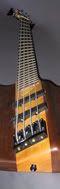
Little Guitar Works have designed a bass guitar with a twist. I’m not talking about your usual gimmicks this guitar really does have a huge twist in it’s neck! 35 Degree’s to be exact 15 at the bridge and 20 at the nut. The strings on this instrument are still straight just the bridge leans one way and the nut leans the other.

Why have they does this?
They made it like this to make it easier and more comfortable to play. It also helps people with Carpal Tunnel Syndrome (CTS), tendonitis, and other "overuse" injuries. It can be used by all players to lower the risk of these playing related problems.
The rotation in the neck minimizes how much your wrist twists while you play. The twist at the bridge is to ease the bending of your right wrist. They have also considered the shape of the bass to maximize comfort and playability. Such as how it balances on a strap or on your knee while sitting.
Cost : unknown - You have to have one custom made.
Website : http://www.littleguitarworks.com/
Tom Boyd
Subscribe to:
Comments (Atom)
